The "Wrong-Note" Prelude of Final Fantasy I (1987 NES)
A J Greengrove
Last updated: ; Published:Table of Contents
The very original NES prelude way back in 1987 from Final Fantasy I behaves differently from the ones to follow, as we’ll se Nobuo himself demonstrating. I hear a swirling kaleidoscope in the inverted arpeggios, so I cover them with the guitar. Let’s peek into the colored glass and some untapped game music potential.
Prologue: Walkthrough and Guitar Cover Videos
Here’s this blogpost’s video entry in the Decrypting Game Music Theory Gems -series, if you prefer a video as a starting point:
To listen while we decrypt the music theory behind the soundtrack, here’s my guitar cover video:
Here's timestamps to explore this audio dungeon:00:00 The arpeggios begin. Notice avoiding the lowest note (programming error in NES)
00:12 Mr. Dudley reads the ensuing harmonies as a ’50s Progression (I vi IV V), which I challenge
00:36 Victory topos AKA double backdoor cadence (lol) AKA Mario cadence = bVI bVII I#3
00:48 Loops “from beginning”, as customary in game soundtracks
Deeper floors with more details await in the blogpost down below.
When I covered this with the guitar, for starters, I had to “double-wrap” the arpeggio to fit it in the fretboard. You might want to compare my version to more canonical versions (such as Harpsibored’s example below).
The Key is B-flat Major (not C)
Harpsibored did a nice-sounding harp cover in the original key, albeit didn’t introduce the weird arpeggio “skips” I’ll soon discuss in more depth: for an audio link see cited URL (Uematsu 2022). Most of the comments do not discuss the skip, only one does. However, it seems that they perceive the key signature of B-flat major dramatically differently from C. I’m sure it’s different, but since it is so subjective and doesn’t really lend itself to further discussion relating to compositional quirks, I digress.
Arpeggio: a Mistake or a Happy Accident?
In the PS1 (2002) and Pixel Remaster (2021) versions of Final Fantasy I the prelude doesn’t differ notably, but the NES (1987) is a curious case.
This excellent review discussing Final Fantasy I soundtrack is baffled whether Nobuo knew it would later be for the harp and why it’s “choppier” and whether it had to do with the NES (Jaime squareenixmusic.com, n.d.).
An X/Tweet by Genki links to a videoclip of a series called “Nobuo Uematsu special talk show vol.2” and the clip seems to have originated from a twitch livestream (@Genki_JPN 2025). In the clip Nobuo demonstrates with the piano how the arpeggio should start from the lowest note, but starts with an immediate skip instead, as follows:
(LilyPond code)
#(ly:set-option 'resolution 200)
\version "2.24.4"
\language "english"
\pointAndClickOff
\header { tagline = "" }
melody = \relative bf, { bf_"should be" c d f \bar"||" bf_"is instead" c, d f }
\score {
  <<
    \time 4/4
    \new Staff { \clef "treble_8" \melody }
    \new TabStaff \with {} <<
      \new TabVoice { \melody }
    >>
  >>
}
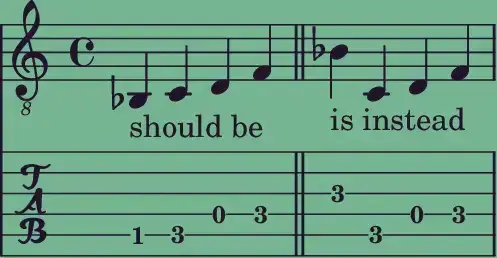
Figure 1: Final Fantasy I Prelude Arpeggio: Intended vs. Outcome
The tweet is phrased so that there’s a “wrong note” in the NES Prelude. In the replies, people get confused hunting for the wrong note but not finding any: they don’t “understand what the error is”. Or “can’t place the wrong not at all”.
Now I think, a correct phrasing of said error is difficult, it would be something like “wrong octave shifts in the arpeggio” or “the arpeggio direction changes happen in the wrong places”.
Gabriel Vieira (@ghcvtunikko) helpfully replied with a translated english spoken audio. According to Nobuo’s way of phrasing I understand that the lowest note/sound(s?) were missing from the program (of the prelude): “this is what ends up playing” and thus the arpeggios begin from the higher notes.
What he actually wanted was what would be corrected for later instances, from Final Fantasy II onwards.
He calls it a very unnatural arpeggio, and I would agree to an extent that it is musically challenging. Then he says it has a strangely unique flavor, and the interviewer/host proceeds to say “it’s a happy accident, one could say”. But I would also see it as a refreshing compositional challenge: I got so inspired by this I live streamed composing a vgm piece filled with wrong notes and arpeggios with erroneous octave shift placements.
Also, TooMuchCoffeeDrunk ⩗ (@much_drunk) says “It sounds better with the wrong note.”; I would say, it sounds more interesting, or as Nobuo and the interviewer/host discuss, J (@Zeppelin041) provides an ultimatum: “lol, there’s a wrong note in all music, that’s what makes it music.”, so true, I’d add.
Before demonstrating with piano, Nobuo mentions that the programmer Nasir Gebelli works constructing block of flats or something. Now I have to say, whether mistake or not, in my book it’s a musically genius one.
I wouldn’t had found this delicious easter egg without the excellent Final Fantasy Fandom / Wiki.
Harmony: How Similar is The ’50s Progression to The Romanesca?
I found an interesting hearing of the harmony (Dudley 2018):
Prelude is written in the key of Bb major and mostly consists of a set of arpeggiated chords known collectively as the ’50s progression (ubiquitous in ’50s/’60s pop music, but also pops up in classical music as far back as the 17th century)
Dudley didn’t cite this one, but it didn’t take me long to find that it is the ’50s progression wikipedia article that cites the 17th-century classical music, I was sad to find it heavily lacking in proper citations. And no further clarification for Pachelbel’s Canon, which would had help me tremendously in my further Final Fantasy I soundtrack discussions. ; )
I removed the wikipedia 17th-18th century examples here but do argue that there’s a clear link between
- the Romanesca,
- Pachelbel’s canon,
- the fashion in harmonic progression of the 1950s-60s,
- and Nobuo Uematsu’s Final Fantasy I soundtrack.
The Romanesca is a beast - spanning centuries - so it deserves an article of its own. However, in case you’re wondering, Gjerdingen’s Music in the Galant Style (Chapter 2: Romanesca) PDF is actually publicly available from his monumental book, also featuring Pachelbel’s Canon as an example (Gjerdingen 2007).
I have explored Romanesca plenty (in my compositions too), as can be browsed in my Posts tagged as Romanesca, but be warned, I’m referring to the Romanesca family of schemata, not Galant-flavored instances in particular.
There’s another aspect to be discussed, though: it is the placement of the harmonies that gives this Prelude musical depth, I argue.
(LilyPond code)
#(ly:set-option 'resolution 200)
\version "2.24.4"
\language "english"
\pointAndClickOff
\header { tagline = "" }
chordprog = \chordmode { bf1 g:m bf g:m ef/g f/a af:maj7 bf:maj7 }
bassline = \relative c {
  bf1_"(in C-major)" | g |
    bf_"* 1950s Progression" |
  g | g | a_"* (ends)"
  gf | af |
}
\score {
  <<
    \time 4/4
    \new ChordNames { \chordprog }
    \new Staff { \clef "bass" \bassline }
    \new TabStaff \with {} <<
      \new TabVoice { \bassline }
    >>
  >>
}
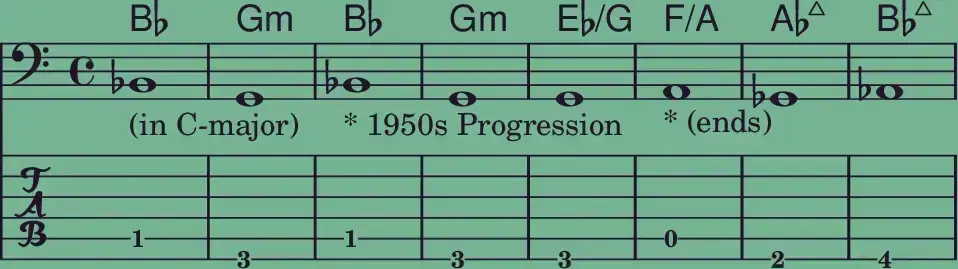
Figure 2: Final Fantasy I (intended) Prelude Arpeggios: 50s Progression?
Isn’t the 50s progression a schema where the I vi IV V starts on a hypermetrically stronger placement? To clarify, either it would start at measure 1 as an “opening gambit”, or then start at measure 5, the F and G would function cadentially stronger?
The of Prelude ends with the last two measures having bVI and bVII, and our dear friend has many nicknames, at least the Mario Cadence for game composers and the double backdoor cadence for pop/jazz, I’d imagine.
But in academic circles it is known as the victory topos. Let me paraphrase on video game toposes, translated to english: “the essential feature is major chords rising in three sequential whole steps: thus, IV V VI#3 uses the victorial topos, as heard in the Main Theme of Genshin Impact. The difference is the goal: in Mario it’s the tonic (I), in Genshin Impact the topos takes us away from the tonic (He 2024, 21).
The “Story” of The Prelude in The Character Creation Screen
I have, for a long time, planned to write a blogpost, could be named something like “the mandatorily sad menu music”. Point being, many good game menu themes have a sad, melancholic, or perhaps nostalgic feel to it. Think Dearly Beloved from Kingdom Hearts (Shimomura 2002) or The Promise from Final Fantasy XIII (Hamauzu 2010).
Instead of the 50s progression, I hear the first half as (in roman numeral harmonic notation) I vi I vi, and second as IV/6 V/6 bVImaj7 bVIImaj7. The ingenuine part is that the IV-V movement is, for a lack of better term, “symmetrical” to the bVI bVII part. A music theorist familiar with Neo-Riemannian way of thinking could probably describe it as a transformation in algebraic terms. Feels like alchemy to me.
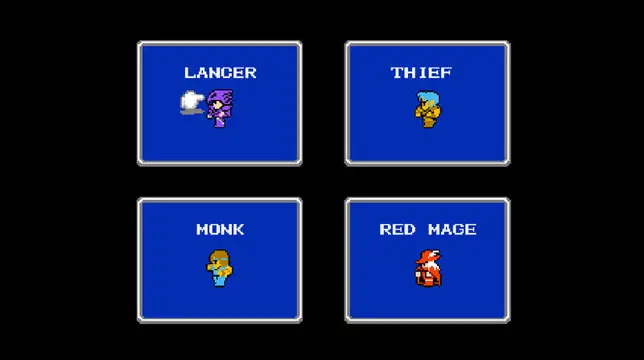
Figure 3: Final Fantasy Renaissance - Party Creation Screen
But in simple terms, the first half, in a way, descends; and after the IV/6 the second half ascends. It’s like a statement pretending to be a blank canvas; just like the character creation screen gives the illusion of a blank state, but in reality the character creation can be a playable experience or a miniature adventure in itself. Especially in Final Fantasy I (and Final Fantasy Renaissance!).
On how the compositional choices affect the game, this “Review by Jaime” from Square Enix Music Online makes good points: at first he mentions that the pieces do not end on a strong cadence, so as to make the loop seamless (Jaime squareenixmusic.com, n.d.). It might seem obvious, but the reason I wanted to point this out is that Eric Heberling’s Elder Scrolls II: Daggerfall soundtrack is the most obvious use of this technique, since in many of the tracks the final dominant harmony remains for multiple measures. In Nobuo’s case, he would vary the techniques as the Final Fantasy series would go on.
There’s something I would like to quote now, to keep in mind for future writings (emphasis mine):
From the basic foundation laid by these two soundtracks, the main evolution would come from increasing the particularization of the themes — different themes for important areas, characters, etc. which, although not present here, will slowly appear beginning already with the third game on the franchise (but that’s another story which must be told in another time…) — Jaime (squareenixmusic.com)
This, dear readers, continues to baffle me and is a topic worthy of later discussions.
The review makes many other good points about Final Fantasy II and the Nintendo era of the series, but I focus strictly on the first installment.
In my first live stream, I use this technique to twist and turn my arpeggios down and up like in this original NES prelude to compose my own game soundtrack.
Links
If you prefer music streaming distributors: Spotify and the like, here’s a “smart Link” for this “audio dungeon” (apple music must be searched):
https://snd.click/a-j-greengrove-250825
Here’s “Final Fantasy I Complete (Game Guitar Covers)”, an updating playlist: