Exploring "False Relations in an English Town"
A J Greengrove
Published:False Relations in an English Town: “Dalza’s basse danse meets the english cadence”.
(Note to reader: these are my earlier blogposts heavy in music theory and meandering in thought. I’ll slowly revisit and backlink posts to clarify things.)
As far as I remember, in this improvisation I ripped off one of Joan Ambrosio Dalza’s basse danses or pivas. However, the main gist was to test out a final cadence with false relation; also known as “english cadence” in renaissance music. Maybe calling the final cadence a “motif” is a bit incorrect, heh.
To peek into this ‘audio dungeon exploration’ before shopping it in the Bandcamp market (for name your gold coins):
It might make sense in the future to relate this improvisation with the style of renaissance lute composers such as Luys Milan, but right now I will leave this post deliberately short. A few points for the future:
- techniques by other renaissance composers to improvise on top of a drone or single-note bass,
- Luys Milan and other composers utilizing guitar-friendly imitations between bass and upper voices,
- english cadences by english composers, Thomas Tallis comes to mind,
- and finally, other false relations: late renaissance or early baroque France comes to mind.
(LilyPond code)
#(ly:set-option 'resolution 200)
\version "2.24.4"
\language "english"
\pointAndClickOff
\header { tagline = "" }
melody = \relative a' { \parenthesize a4 gs8 fs gs4. a8 a1\fermata }
bass = \relative e { e2 f?4 e a,1\fermata }
\score {
  <<
    \new Staff { \clef "treble" \melody }
    \new Staff { \clef "bass" \bass }
    \new TabStaff \with {} <<
      \new TabVoice { \melody }
      \new TabVoice { \bass }
    >>
  >>
}
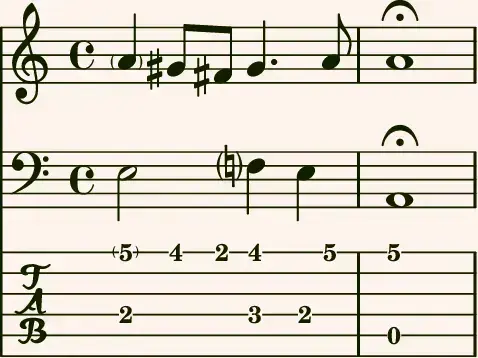
Figure 1: “False Relations in an English Town” Motif
Here’s the recording session video of the piece: